
Fresh nails inspiration does not have to come from familiar flowers, fruit, hearts, glitter, or glossy gradients. Everyday objects can create ideas because their shapes form a visual story. The six concepts below explore mechanical flipboards, shadow puppets, matchbook covers, bowling lanes, paper dioramas, and chess clocks.
Each theme includes three directions for short square, rounded, oval, or almond nails. Colors can change, but every manicure should keep one idea throughout.
Mechanical Flipboard Nails With Changing Tile Rhythm
Mechanical flipboard nails take inspiration from information boards built from rotating panels. Black, cream, tomato red, cobalt, and pale gray create a crisp palette.
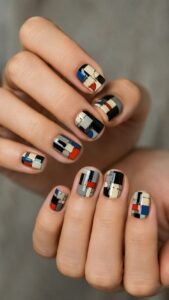
Divided rectangles, cropped symbols, and misaligned rows make the display look caught between messages. Short square nails suit the compact structure, while almond nails support longer arrangements.
Build Split Tiles Without Readable Words
Cover the nail in warm cream, then arrange two or three black rectangles with a fine gap through each center. Paint only part of a curved or angled symbol inside every tile instead of a complete letter.
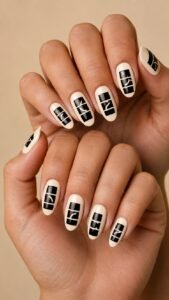
The unfinished markings suggest movement without creating readable text. Change the tile sizes across the hand so the design never resembles a repeated keyboard.
Turn Number Windows Into Color Blocks
Use charcoal as the foundation and place a tomato red window close to one side. Add a smaller pale gray panel underneath, separated by a narrow dark strip.
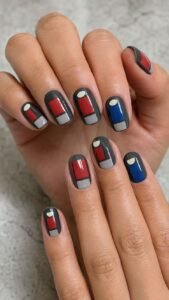
One cream half circle inside the upper block can suggest a changing number without forming one. Cobalt on another nail brings a surprising fashion color into the mechanical palette.
Offset the Rows for Mid Change Motion
Create two rows of narrow cream panels over black, then shift the lower row slightly to the right. Place a tiny coral edge above one panel as though the next tile is rotating.
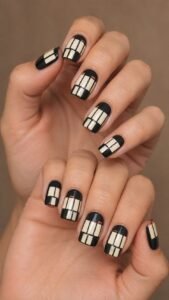
On shorter nails, use only three staggered pieces. The uneven alignment gives energy without shimmer, raised gel, or decorative charms.
Shadow Puppet Nails With Cinematic Silhouettes
Shadow puppet nails use cropped silhouettes over warm illuminated backgrounds. The image is suggested through shape rather than tiny realistic details. Sand, apricot, muted rose, cocoa, and deep black create the feeling of light crossing a screen.
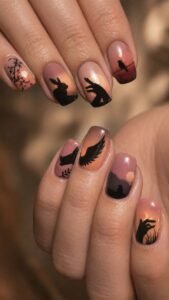
Rounded nails soften the silhouettes, while square shapes sharpen the framing. Different scenes can appear across both hands while repeated tones connect them.
Cast a Bird Wing Across Apricot
Paint the nail in softened apricot and sweep a black wing from one corner toward the center. Use three broad feather points rather than many narrow lines, allowing the silhouette to stay readable on short nails.
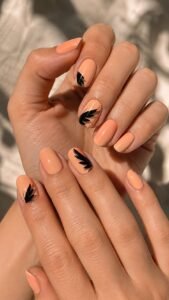
A small cocoa shadow beneath the wing adds depth. Another finger can show only the final feather entering from the edge.
Shape a Rabbit Profile Near the Cuticle
A warm sand background gives enough contrast for a small black rabbit profile near the cuticle. Keep the ears long and simple, then stop the body before the middle of the nail.
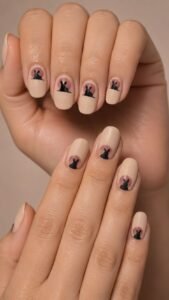
A muted rose circle behind the silhouette can suggest stage lighting without becoming a gradient. Leave the upper area open so the character remains clear.
Form an Abstract Animal With Hand Shapes
Combine two overlapping hand silhouettes that suggest a fox or bird without painting a literal animal. Place the shapes over dusty cream and make one finger slightly lighter than the other so the overlap stays visible.
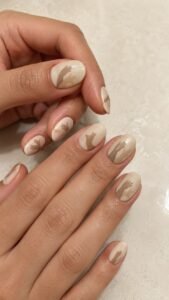
This interpretation feels editorial and works best on medium oval nails, where the unusual profile has enough room.
Matchbook Cover Nails With Folded Graphic Character
Matchbook cover nails borrow bold colors, compact borders, striker textures, and rows of unused matches. The look feels nostalgic without flames or familiar logos. Brick red, mustard cream, navy, faded pink, and cocoa gray create a collected palette.
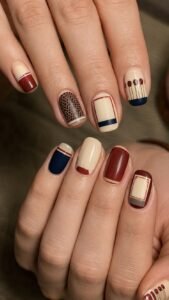
Each design should resemble part of a folded paper object rather than a flat print. Satin color beside glossy details separates the smaller components.
Fold a Brick Red Cover Around the Side
Place brick red across most of a cream nail, leaving one narrow angled section uncovered near the edge. Add a thin navy line where the fold appears to turn inward.
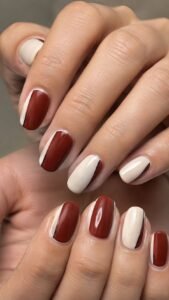
The red shape should wrap visually around the side instead of sitting as a centered rectangle. Another nail can carry only the navy fold line over cream.
Line Up Unused Matches Beneath the Flap
Create a faded pink cover at the tip, then paint four slim cream matches beneath it with tiny cocoa heads. Keep every match unlit and evenly spaced, but allow one to sit slightly lower.
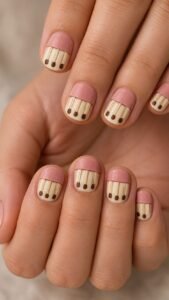
This irregularity prevents the arrangement from looking like ordinary stripes. Short square nails naturally support the compact row and folded flap.
Add a Cocoa Striker Strip Near the Base
A mustard cream background makes a narrow cocoa strip near the cuticle feel graphic and intentional. Texture it with tiny irregular marks in a lighter brown, avoiding perfect dots or repeated lines.
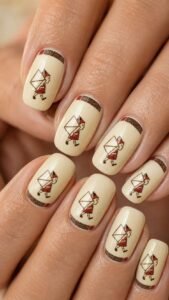
Place a small brick red tab beside the strip to echo the cover color. The detail remains subtle from a distance but interesting up close.
Bowling Lane Nails With Polished Retro Geometry
Bowling lane nails use warm wood tones, directional arrows, rounded ball shapes, and glossy floor reflections. Maple beige, caramel, coral, powder blue, and deep navy feel cheerful without becoming childish.
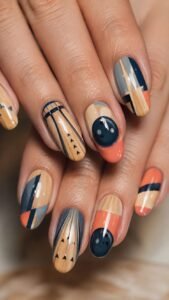
Long nails can show extended boards, while short nails can focus on one cropped detail. The concept looks strongest when straight movement is balanced by one bold circular form.
Stretch Maple Boards Toward the Tip
Paint alternating maple and caramel sections from the cuticle toward the tip, keeping the widths slightly different so they resemble real boards rather than uniform stripes. Add one thin navy division line on selected nails.
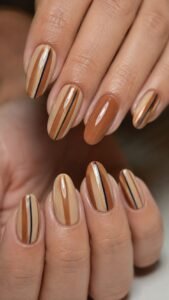
The direction naturally lengthens short shapes. A plain caramel finger between detailed nails gives the eye a quiet pause.
Crop a Coral Ball Into the Corner
Place a large coral circle partly beyond the lower corner of a powder blue nail. Add three tiny navy openings in an uneven triangle, making the object recognizable without showing the complete ball.
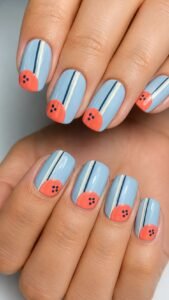
Reverse the corner on the opposite hand for natural movement. The bold circle breaks up the straight lane details and creates an energetic focal point.
Mark the Foul Line With Blue Arrows
Use warm beige as the base and paint one narrow navy line across the lower third. Above it, add two powder blue arrows pointing toward the tip with generous space between them.
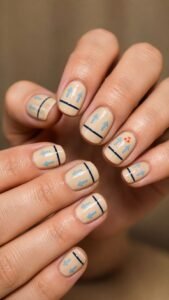
Keep the arrows broad enough to remain clear on short nails. A coral mark on one finger can connect this detail with the ball accents.
Cut Paper Diorama Nails With Layered Scenic Depth
Cut paper diorama nails create depth through flat overlapping shapes rather than transparent color, sculpted gel, or realistic painting. Coral, clay, plum, pale peach, teal, and soft black can form miniature scenes that look like stacked paper.
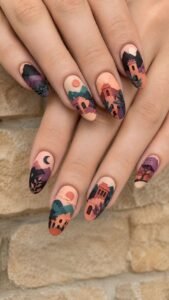
Crisp edges keep each layer visible. Almond nails support taller compositions, while short rounded nails can show cropped scenery. Repeating the palette keeps both hands coordinated.
Stack Desert Hills in Coral and Clay
Start with pale peach and place a wide clay curve across the lower portion. Add a smaller coral hill behind it and a narrow plum ridge in the distance. Do not blend the layers, because their clear edges create the cut paper effect.
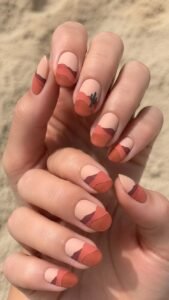
A single soft black cactus may appear on one nail, while the others rely only on landscape shapes.
Build Teal Rooftops Against Peach
Create a peach background and add two overlapping teal rooftops near the tip. One roof can have a square chimney, while the other uses a slanted edge.
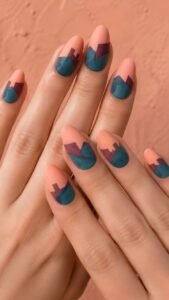
A slim plum building behind them introduces another depth level without tiny windows or lettering. Cropping the scene at the edges makes the arrangement feel larger and more modern.
Frame a Stairway Through Dark Layers
Paint a soft cream base, then place two deep plum wall shapes along opposite sides, leaving a narrow stairway opening through the middle. Add three clay steps that become smaller toward the tip.
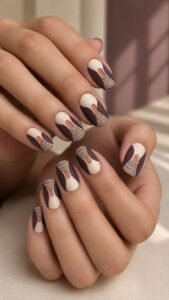
A muted coral doorway at the end creates a destination. The layered perspective feels dimensional even though every element remains flat.
Chess Clock Nails With Strategic Color Blocks
Chess clock nails focus on paired time windows, push buttons, dividing lines, and two sides sharing one object. The theme avoids traditional boards and detailed pieces.
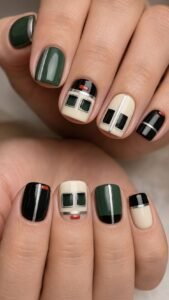
Black, ivory, racing green, signal red, and soft silver create a strong graphic palette. Square nails suit the rectangular display, while oval nails can carry cropped corners. Every detail should look purposeful.
Divide Two Time Windows in Black and Ivory
Cover one nail in racing green and place two small rectangles side by side, one black and one ivory. Separate them with a slim silver divider. Add one tiny cream mark inside the black window and a dark mark inside the ivory window, keeping both abstract.
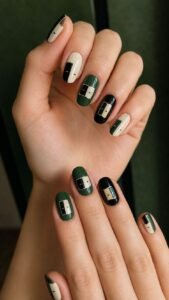
The mirrored contrast suggests two opposing sides without numbers or letters.
Press a Signal Red Button at the Cuticle
Paint a soft ivory base and place one rounded signal red rectangle near the cuticle. A narrow black shadow beneath it creates the appearance of a button ready to be pressed.
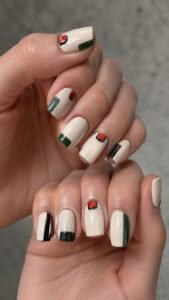
On another finger, move the red shape toward the side and reduce its size. The bright accent brings tension to the controlled black, green, and cream palette.
Trace a Knight Move With Corner Blocks
Use black polish and add three small ivory blocks arranged in an L shaped path. Place a racing green square at the final position to show where the movement ends.
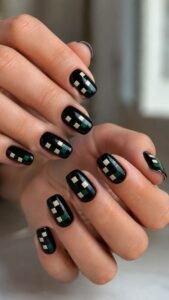
Keep the blocks widely spaced so the layout does not resemble a board pattern. This interpretation refers to strategy through placement alone and remains easy to wear.
Choose Nails Inspiration That Feels Truly Different
Original nails inspiration becomes easier to recognize when every manicure tells a clear visual story. Mechanical flipboards bring changing tile movement, while shadow puppets create cinematic silhouettes. Matchbook covers offer folded graphic character, and bowling lanes combine polished lines with playful circular accents. Cut paper dioramas introduce scenic depth, while chess clocks build tension through paired windows. Choose the concept that fits your nail shape and wardrobe, then adjust the colors without changing its central identity. Related articles about short nail ideas, manicure colors, outfit styling, jewelry combinations, hairstyles, hand care, and beauty details can complete the look.
